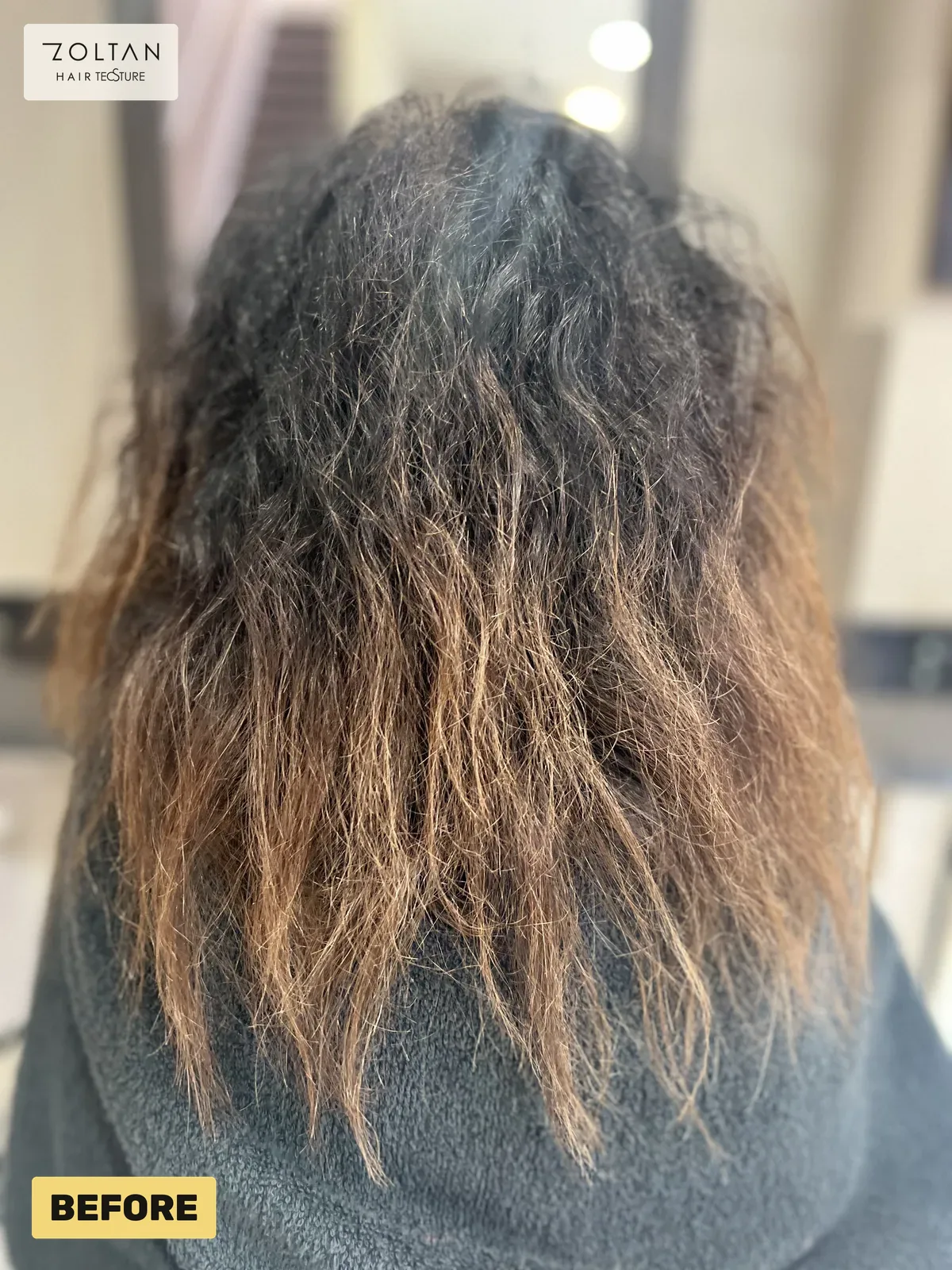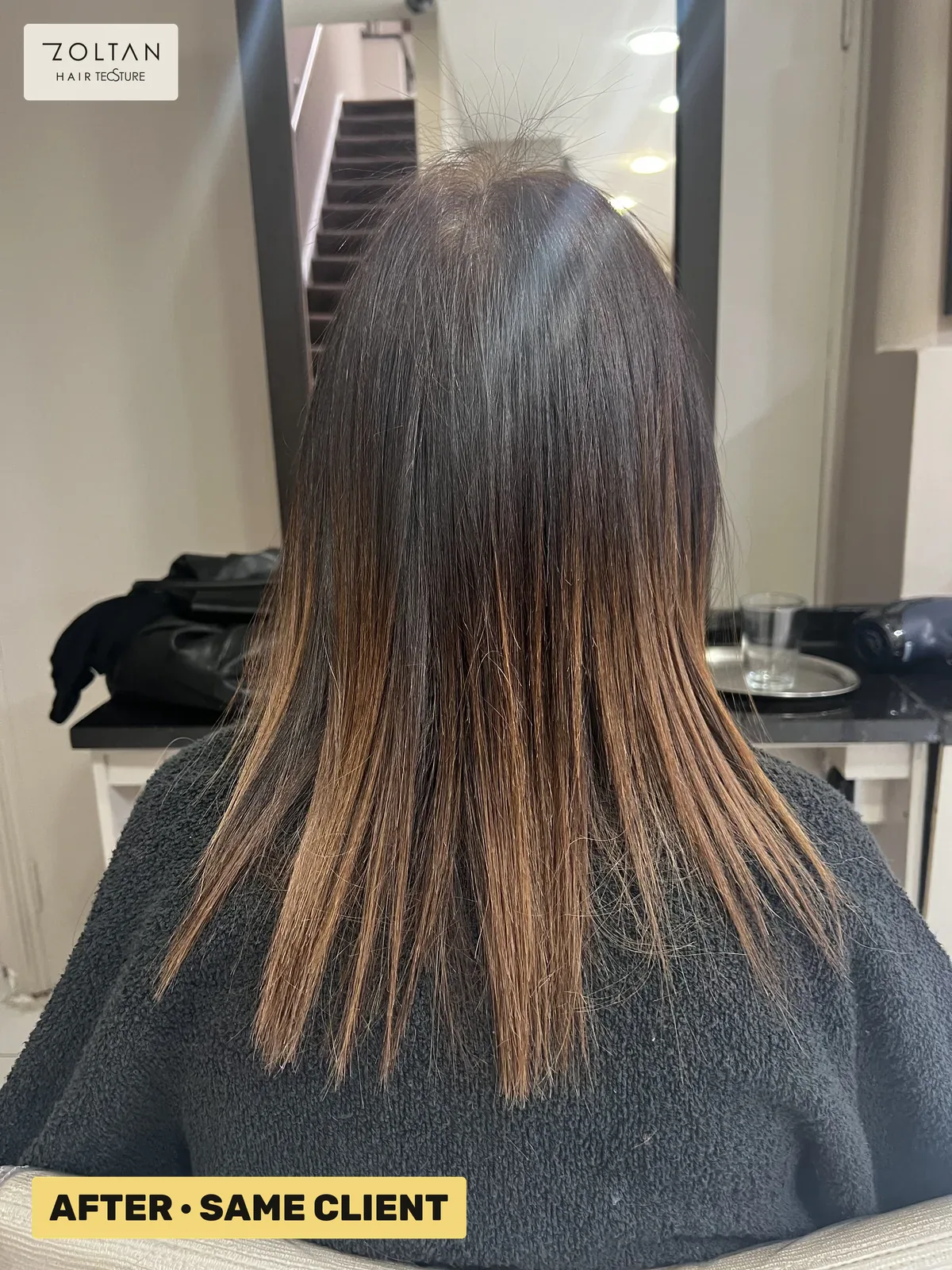
Zoltan Hair · Mayfair · Correction · someone else's work
Straightment Correction
A treatment somewhere else has gone wrong, or gone nowhere. Before anything else: stop, do not let anyone put another chemical on it, and read the next section — most of the damage done after a bad treatment is done in the fortnight that follows it.
See prices & bookAll treatmentsread this first
quoted after I have seen it
and what cannot
Read this first
What to do today, before you book anything
This costs you nothing and it matters more than which salon you choose next. Most hair that is beyond saving got that way after the bad appointment, not during it.
1 · Put nothing else chemical on it
No corrective treatment, no “repair” service, no colour to cover it, no relaxer, no second keratin to fix the first. Stacking chemistry on compromised hair is how hair is lost — thio on hydroxide, in particular, can dissolve it. Whatever you have been offered as a quick fix, wait until someone has looked at it properly.
2 · Stop the heat
No straighteners, no tongs, no hot blow-drying. Damaged hair has a raised, broken cuticle and holds heat differently — the iron that was fine last month is not fine now. Air-dry, or blow-dry cool and gently.
3 · Handle it as little as possible
Wet hair is at its weakest and damaged wet hair is weaker still. Do not brush it wet, do not tie it tightly, do not scrub at the scalp. Wide-tooth comb, conditioner in, fingers only.
4 · Wash gently and less often
Mild shampoo, cool water, conditioner every time. Twice a week rather than daily. If the salon sold you an aftercare product and the problem started with it, stop using it.
5 · If your scalp is burned, see a doctor first
Blistering, weeping, open sores or ongoing pain are a medical matter, not a hairdressing one. Go to a GP or a pharmacist before you go to any salon, including this one. I will not treat a damaged scalp and neither should anyone else.
6 · Photograph it, in daylight
Wet and dry, front and back, near a window rather than under a bathroom light. Purely so I can see how it is changing between now and when you come in — hair moves in the first fortnight after a bad treatment, and seeing that progression tells me more than one look on the day.
Before anything else
Everything you do to your hair costs it something. Including nothing.
This is the part most salons leave out, so I would rather you had it first.
Think about a bag you actually like
Not the one in the box — the one you have carried every day for three years. Rained on. Put down on the floor of the tube. Stuffed too full. Keys rattling around in it. It does not look like it did in the shop and it never will again. That is not neglect. That is what carrying it every day does.
Your hair has been with you far longer
The lengths on hair past your shoulders are often four, five, six years old — grown, then worn, every single day since. Rain. Sun. Hard London water. A hairband. A brush pulled through it when you are late. A towel. A pillow. A blow-dry. An iron at 200 degrees because it would not sit down otherwise. None of it dramatic, all of it adding up — and unlike skin, hair does not repair itself. What happens to it stays happened.
And you never notice you are doing it
Nobody stands at the mirror thinking that is damage. You put it up because it is windy. You go over it again because one bit will not sit down. You rub it dry because you are late. It is automatic, it is every day, and it is a couple of thousand small decisions a year that nobody counts. A treatment is the one thing on that list you actually decide to do — which is why it feels like the risky one, and why it gets all the blame.
So the honest question is not “will this damage my hair?”
Everything does. The question is what you spend, and what you get back for it.
What usually went wrong
In nearly every case I see, it is one of these six. None of them is your fault, and none of them means you did something stupid.
The wrong chemistry for the hair
The most common by a distance. A strong treatment put on hair that could not take it — usually bleached or previously processed hair — because nobody asked for the history, or asked and did not act on the answer.
Over-processing
Left on too long, or timed by the clock rather than checked on the hair. Porous hair processes far faster than the tube says. Once it is over-processed there is no taking it back.
Incompatible chemistry stacked
Thio over hydroxide relaxer, a perm over a straightening treatment, chemistry over henna or metallic salts. These combinations do not merely disappoint — some of them dissolve hair, and it happens in the chair.
Rushed or skipped neutralisation
The classic perm and permanent-straightening failure. The bonds are opened and never properly closed, so the result drops within days and the hair is left structurally compromised. Almost always a time problem, not a skill problem.
Heat damage on top of chemistry
Too hot, too many passes, sections too thick. The treatment may have been fine; the iron finished the job. This is the one where the ends go first and the mid-lengths follow.
It simply did not work
Not damage at all — a treatment that cost you three hundred pounds and did nothing, or dropped out in three weeks. Usually the wrong product, applied too weakly, or stripped by the aftercare you were sold alongside it.
The hard part
What can be fixed, and what cannot
I would rather lose the booking than tell you what you want to hear. Here is the truth of it, and it is not all bad.
Hair does not heal
It is not living tissue. Once the cystine in the cortex has been oxidised to cysteic acid, that is permanent — no product, no bond builder and no treatment reverses it. Anything sold to you as “repair” is filling and coating, which is genuinely useful and is not the same as healing.
Some of it will have to come off
Where the structure has gone, the honest answer is scissors. Not always all of it, and often less than you fear — but a correction that promises to save every inch is a correction that will fail. We take the length down as far as it needs and no further.
What can genuinely be improved
A great deal. Evening out a half-processed head, removing a hard demarcation line, rebalancing protein and moisture, restoring condition and shine to hair that is compromised but not destroyed, and getting the hair to a state where it can eventually be treated properly again.
A failed result can often be redone
If the treatment simply did not work and the hair is not damaged, this is straightforward — the right chemistry at the right strength, and you get what you paid for the first time. This is a good proportion of what I see.
Some of it is time
Sometimes the correct answer is three to six months of doing very little, gentle care and regular small trims, and then a treatment. If that is the answer, that is what I will tell you — and it will cost you a consultation rather than four hundred pounds.
I am not a magician
Some hair arrives beyond what any technique, product or amount of money can do. It is not common, but it happens, and when it does no amount of skill changes it. I would far rather tell you that at the consultation than after you have spent four hundred pounds finding out.
It is expensive — and not only the appointment
Be realistic before you start. There is the correction itself, and then there is what it actually takes: home products you will genuinely need to buy and keep buying, and months of your time and patience. Correction is slow work done gently, mostly by you, between appointments. Anyone offering to fix it in one afternoon for a modest fee is not describing the same thing.
And occasionally it is a cut
Rarely, but it happens: the fastest route back to hair you like is a shorter cut and starting again. I will say so if I think it, and I would rather say it than sell you a correction that postpones the same conversation by six months.
How a correction actually works
Assessment first, always
I need to see it and touch it. Correction is the one thing I will not quote from a photograph — the difference between damaged and destroyed is something you feel, not something a picture shows.
Test strands
This is where testing is not optional. Before anything is put on your head, it goes on a strand and I watch what happens to it.
Staged, not heroic
Often more than one visit, deliberately. Doing less and coming back is how compromised hair is brought round; doing everything at once is how it is finished off.
A plan you keep
You leave with the sequence written down — what happens now, what happens in six weeks, what to use at home, and when your hair could take a proper treatment again.
Who this is for
Come in
Damage at D – DD · uneven, dropped or half-processed
A treatment that failed, dropped out, went patchy, left a hard line, or left the hair rough and dull. Hair that is compromised but still has structure. This is most of what walks through the door and most of it improves.
Come in, but read the honest part
Damage at DDX · ends beyond saving
Where the ends have gone, the correction includes taking them off. I will show you where the line is on your own hair and let you decide. Nobody is cutting anything without your agreement.
Doctor first
Burned, blistered or painful scalp
A chemical burn is a medical problem. See a GP or pharmacist before any salon. Come back to me once the scalp has healed — I will still be here and your hair will still need sorting out.
No surprises
Things I would rather you heard from me than found out in the chair
None of this is in anybody else's brochure. It is all true, and knowing it in advance is the difference between a surprise and a plan.
It will smell
Anything heated to 200 degrees smells — think of food. Your own mousse or styling product on there smells too. Some treatments frankly smell like wet dog for a day. I work next to an open window and it clears, but I am not going to pretend it does not happen.
Some treatments shift your colour
Not all, but some will lift or warm what is already on your hair. If that applies to yours I will tell you before we start and we plan around it. I spent years as a colourist, so this is a conversation rather than a surprise at the mirror.
It can go flat
Certain hair looks bouncy for a fortnight and then sits down. I can usually work around it — leaving the roots alone, choosing a lighter strength, changing where I place the tension. But only if I know beforehand that volume matters to you. Say it at the consultation, not afterwards.
Damage is the thing we are trying not to do
These are chemical services and they are not free. Done properly on suitable hair the trade is small and worth it. Done wrong, or on hair that has already been through too much, it is breakage — which is exactly why sometimes the answer is no.
The first two visits, we are getting to know each other
This is the most useful thing on the page, and the thing almost nobody says out loud.
The first appointment is a learning appointment
I do not know your hair yet — and I do not know you. I know the chemistry; I do not yet know how yours takes it, what the last person left in it, or the life it has to survive: your mornings, your training, your travel, how much time you will honestly give it. So I work carefully the first time, and careful means slightly under rather than slightly over. That is deliberate. I can always add more next time. I cannot take it back out.
The second visit is where it comes together
By then I have seen how your hair behaved, how long it held and what it did in week six — and you have lived with it, and can tell me what you actually thought. Now I can push further or pull back with something real to go on. If the first result is good but not quite it, that is not a failure. That is the information.
My “perfect” and your “perfect” may not be the same thing
I might look at your hair and see a result I am pleased with — even, healthy, doing exactly what the chemistry should do. You might look in the mirror and want it flatter, or curlier, or with more root left in. Neither of us is wrong. We are looking at different things.
So tell me, in your own words
Tell me what you want it to look like before we start, and tell me afterwards if it is not that. Not to complain — so I can adjust it next time. The clients whose hair I get right consistently are almost always the ones who told me what they actually wanted on visit two.
And the honest end of it: maybe I am not the right stylist for you. I am not saying I am — I am trying, and by the second visit we will both know. I would rather give you that sentence than a guarantee nobody could honestly make.
I do not criticise other hairdressers. Ever.
You will get no lecture from me and no theatrical horror at what was done. I have seen it many times, it is almost always one of six ordinary mistakes, and being made to feel foolish about it helps nobody.
I will also not tell you who to blame. I have made mistakes in my own career and learned from them, which is most of how anyone learns this trade. I am not prepared to be the person who damages someone else's livelihood over a bad day, and I will not provide statements, reports or opinions to anyone pursuing it — I have been asked plenty of times, including by insurers, and the answer does not change.
Almost everyone who books a correction apologises at some point during it — for being taken in, for not asking more questions, for going somewhere cheaper. None of that is warranted either. My job starts and stops at your hair.
Colour
If you were about to colour it
A great many people try to cover a bad treatment with colour. It is an understandable instinct and it is usually the wrong move.
Do not colour it yet
Wait for the assessment
Colour is another chemical process on hair that has just had one go wrong. It also changes what I can safely do next — sometimes closing off the correction entirely.
Especially not bleach or lightening
This is the one that ends it
Lightening compromised hair is how the merely damaged becomes the unsalvageable. If you have been offered highlights to disguise a bad treatment, decline.
Colour usually comes later
And often it can
Once the hair is stable, colour is frequently possible and part of the plan. It is a question of sequence, not of never.
Skin test
I do not routinely do one for straightening or perming, and there is no blanket UK requirement for these services — it is the product manufacturer and the insurer that drive it, not the law. Where a specific product calls for one, I will tell you and we will do it. Hair colour is a different matter: there it is effectively mandatory.
Strand and elasticity testing
Also not routine. I read the hair at the consultation and again on the day. Where I judge it necessary, I will say so before we start — and we test before anything else happens, rather than finding out halfway through.
What actually protects the hair
Knowing what has already been done to it. Colour history, previous chemistry and how it was cared for tell me more than any test — which is why I ask for the history before I ask what you want.
What you do at home matters more here than anywhere
Protein and moisture, in balance
Compromised hair goes wrong in both directions. Stiff, brittle and snapping means too much protein; gummy, stretchy and limp means too much moisture. Most people over-correct with protein because it is what the packaging promises. I will tell you which one yours is and roughly when to switch.
Gentle, and less often
Mild shampoo, conditioner every single wash, cool water, twice a week. No daily washing, no scrubbing, no brushing it wet.
Send me the ingredient list
Whatever is in your shower now, photograph the back of the bottle and send it. Half the corrections I see are being made worse at home by a product that was recommended in good faith. This offer stands whether you book with me or not.
The terms, plainly
The same glossary appears on every treatment page here, so the language means the same thing wherever you read it — with what each term means for this particular treatment underneath.
pH
The acid-to-alkaline scale. Hair sits at about 4.5–5.5, slightly acidic. Alkaline products swell and open the cuticle so chemistry can get in — more change, more cost to the hair. Acid products close and smooth it — gentler, shinier, less penetration.
On a correction: the first thing I check. Compromised hair is often left sitting alkaline, which keeps the cuticle open and the damage progressing. Getting it back down to a healthy acid pH is frequently the first useful thing done to it.
Disulfide bonds
The strong, permanent sulphur-to-sulphur links. They give hair both its strength and its bounce. Hydrogen bonds, by contrast, are weak and temporary — broken by water and heat, which is why a blow-dry drops in the rain.
On a correction: the whole question. How many are intact decides everything about what is possible — and where they have been oxidised to cysteic acid, no treatment brings them back.
Porosity
How easily hair absorbs and holds water and chemicals. High porosity means a raised, damaged cuticle: it soaks product up fast and processes quickly and unevenly. Low porosity is resistant and needs more time.
On a correction: usually high and usually uneven, which is the real difficulty. Different parts of the same head absorb at different rates, so anything applied evenly lands unevenly.
Bounce (elasticity)
The ability to stretch and spring back, governed almost entirely by disulfide bond health. You can impose a shape on almost any hair. You cannot impose bounce — it has to be earned from healthy bonds.
On a correction: the test that tells the truth. A wet strand stretched gently either springs back, stays stretched or snaps — and that, more than how it looks, decides what happens next.
Reduction and neutralisation
The two-step chemistry of any perm or relaxer. Reduction breaks the bonds so the hair can be reshaped; neutralisation reforms them in the new shape and locks it in.
On a correction: often exactly what went wrong. A great many corrections are hair that was reduced properly and neutralised badly — opened and never closed.
Processing time
Timed to the hair, not to a clock on the wall. Porosity, texture and history all change how fast a treatment develops.
On a correction: the single most common cause of what I am correcting. Timed to a clock instead of checked on the hair, on hair that was processing twice as fast as the instructions assumed.
Read further
Where this sits in the wider family
The free guides covering each tradition — what is in them, where they came from and who they suit.
Keratin & protein family
Every semi and demi-permanent smoothing treatment that coats and fills the hair rather than permanently restructuring it.
Open the guide →Brazilian & plastia
Nanoplastia, taninoplastia and their siblings — built on organic acids rather than aldehydes.
Open the guide →Japanese & Chinese systems
Shukumo kyosei, permanent thermal reconditioning, and the acid-heat systems built for damaged hair.
Open the guide →Rebonding family
Asia's structural straightening tiers, up to permanent pin-straight.
Open the guide →Korean systems
Magic straight, down perm, and the approach that straightens while keeping root lift.
Open the guide →The complete guide
Every smoothing and straightening treatment sold anywhere in the world, in one place.
Start here →Questions people actually ask
Can you save it?
Sometimes completely, usually substantially, occasionally not. I cannot answer it honestly without seeing it, and anyone who answers that question from a photograph is guessing — including anyone who says yes.
Will I have to cut it all off?
Almost never all of it. Usually less than you fear. Where structure has genuinely gone, that length is coming off eventually whether we do it deliberately now or it snaps off on its own over the next few months. Come expecting that a cut may be part of the answer. It usually is, and it is usually the cheapest part.
Why is it £449.95 and why can you not quote me?
Because no two are the same. It is priced from that point and quoted properly once I have seen it — it might be one long appointment or a plan across several. Quoting a correction blind is how people are overcharged: a comfortable number on the phone that grows once you are committed and cannot leave. £449.95 is a real floor and most run higher. Expect more, and expect the actual figure before we start rather than after.
Can bond builders fix it?
They help, genuinely, and they are part of most plans. But they re-link and reinforce what is still there — they do not regrow destroyed cystine. Anything marketed as reversing damage is overstating itself.
How soon can I have a proper treatment again?
Often three to six months, sometimes sooner, occasionally longer. You will leave knowing the date to aim at rather than wondering.
I had it done abroad and cannot go back. Does that matter?
Not to me. Tell me what you can — the country, what it was called, what it smelled like, how long it took. That is usually enough for me to work out the chemistry involved.
Will you give me a report for a complaint or a claim?
No. I have been asked many times over the years, including by insurers, and the answer has always been the same. I will not do anything that could damage another hairdresser. I have made mistakes in my own career and learned from them, and I am not willing to be the person who ends somebody else's. What you do about it is entirely your right and there are proper channels for it — I simply will not be part of it. My job starts and stops at your hair.
Will you tell me honestly if I should just wait?
Yes, and it happens regularly. If the right answer is three months of leaving it alone, that is what you will hear, and it will cost you a consultation rather than a correction.
Real prices, published.
Four questions about your hair and the calculator gives you the exact price for your length and texture, and the appointment to book. No “from” prices that grow once you are in the chair.
See prices & bookAll treatmentsNot sure this is the right one? A mini consultation online is £9.95 — it is not a deposit and it does not come off the treatment, and every treatment includes a full consultation on the day at no charge.
Zoltan Hair · Mayfair · Correction · someone else's work
Straightment Correction
A treatment somewhere else has gone wrong, or gone nowhere. Before anything else: stop, do not let anyone put another chemical on it, and read the next section — most of the damage done after a bad treatment is done in the fortnight that follows it.
See prices & bookAll treatmentsread this first
after I have seen it
and what cannot
Read this first
What to do today, before you book anything
This costs you nothing and it matters more than which salon you choose next. Most hair that is beyond saving got that way after the bad appointment, not during it.
1 · Put nothing else chemical on it
No corrective treatment, no “repair” service, no colour to cover it, no relaxer, no second keratin to fix the first. Stacking chemistry on compromised hair is how hair is lost — thio on hydroxide, in particular, can dissolve it. Whatever you have been offered as a quick fix, wait until someone has looked at it properly.
2 · Stop the heat
No straighteners, no tongs, no hot blow-drying. Damaged hair has a raised, broken cuticle and holds heat differently — the iron that was fine last month is not fine now. Air-dry, or blow-dry cool and gently.
3 · Handle it as little as possible
Wet hair is at its weakest and damaged wet hair is weaker still. Do not brush it wet, do not tie it tightly, do not scrub at the scalp. Wide-tooth comb, conditioner in, fingers only.
4 · Wash gently and less often
Mild shampoo, cool water, conditioner every time. Twice a week rather than daily. If the salon sold you an aftercare product and the problem started with it, stop using it.
5 · If your scalp is burned, see a doctor first
Blistering, weeping, open sores or ongoing pain are a medical matter, not a hairdressing one. Go to a GP or a pharmacist before you go to any salon, including this one. I will not treat a damaged scalp and neither should anyone else.
6 · Photograph it, in daylight
Wet and dry, front and back, near a window rather than under a bathroom light. Purely so I can see how it is changing between now and when you come in — hair moves in the first fortnight after a bad treatment, and seeing that progression tells me more than one look on the day.
What usually went wrong
In nearly every case I see, it is one of these six. None of them is your fault, and none of them means you did something stupid.
The wrong chemistry for the hair
The most common by a distance. A strong treatment put on hair that could not take it — usually bleached or previously processed hair — because nobody asked for the history, or asked and did not act on the answer.
Over-processing
Left on too long, or timed by the clock rather than checked on the hair. Porous hair processes far faster than the tube says. Once it is over-processed there is no taking it back.
Incompatible chemistry stacked
Thio over hydroxide relaxer, a perm over a straightening treatment, chemistry over henna or metallic salts. These combinations do not merely disappoint — some of them dissolve hair, and it happens in the chair.
Rushed or skipped neutralisation
The classic perm and permanent-straightening failure. The bonds are opened and never properly closed, so the result drops within days and the hair is left structurally compromised. Almost always a time problem, not a skill problem.
Heat damage on top of chemistry
Too hot, too many passes, sections too thick. The treatment may have been fine; the iron finished the job. This is the one where the ends go first and the mid-lengths follow.
It simply did not work
Not damage at all — a treatment that cost you three hundred pounds and did nothing, or dropped out in three weeks. Usually the wrong product, applied too weakly, or stripped by the aftercare you were sold alongside it.
The hard part
What can be fixed, and what cannot
I would rather lose the booking than tell you what you want to hear. Here is the truth of it, and it is not all bad.
Hair does not heal
It is not living tissue. Once the cystine in the cortex has been oxidised to cysteic acid, that is permanent — no product, no bond builder and no treatment reverses it. Anything sold to you as “repair” is filling and coating, which is genuinely useful and is not the same as healing.
Some of it will have to come off
Where the structure has gone, the honest answer is scissors. Not always all of it, and often less than you fear — but a correction that promises to save every inch is a correction that will fail. We take the length down as far as it needs and no further.
What can genuinely be improved
A great deal. Evening out a half-processed head, removing a hard demarcation line, rebalancing protein and moisture, restoring condition and shine to hair that is compromised but not destroyed, and getting the hair to a state where it can eventually be treated properly again.
A failed result can often be redone
If the treatment simply did not work and the hair is not damaged, this is straightforward — the right chemistry at the right strength, and you get what you paid for the first time. This is a good proportion of what I see.
Some of it is time
Sometimes the correct answer is three to six months of doing very little, gentle care and regular small trims, and then a treatment. If that is the answer, that is what I will tell you — and it will cost you a consultation rather than four hundred pounds.
I am not a magician
Some hair arrives beyond what any technique, product or amount of money can do. It is not common, but it happens, and when it does no amount of skill changes it. I would far rather tell you that at the consultation than after you have spent four hundred pounds finding out.
It is expensive — and not only the appointment
Be realistic before you start. There is the correction itself, and then there is what it actually takes: home products you will genuinely need to buy and keep buying, and months of your time and patience. Correction is slow work done gently, mostly by you, between appointments. Anyone offering to fix it in one afternoon for a modest fee is not describing the same thing.
And occasionally it is a cut
Rarely, but it happens: the fastest route back to hair you like is a shorter cut and starting again. I will say so if I think it, and I would rather say it than sell you a correction that postpones the same conversation by six months.
How a correction actually works
Assessment first, always
I need to see it and touch it. Correction is the one thing I will not quote from a photograph — the difference between damaged and destroyed is something you feel, not something a picture shows.
Test strands
This is where testing is not optional. Before anything is put on your head, it goes on a strand and I watch what happens to it.
Staged, not heroic
Often more than one visit, deliberately. Doing less and coming back is how compromised hair is brought round; doing everything at once is how it is finished off.
A plan you keep
You leave with the sequence written down — what happens now, what happens in six weeks, what to use at home, and when your hair could take a proper treatment again.
Who this is for
Come in
Damage at D – DD · uneven, dropped or half-processed
A treatment that failed, dropped out, went patchy, left a hard line, or left the hair rough and dull. Hair that is compromised but still has structure. This is most of what walks through the door and most of it improves.
Come in, but read the honest part
Damage at DDX · ends beyond saving
Where the ends have gone, the correction includes taking them off. I will show you where the line is on your own hair and let you decide. Nobody is cutting anything without your agreement.
Doctor first
Burned, blistered or painful scalp
A chemical burn is a medical problem. See a GP or pharmacist before any salon. Come back to me once the scalp has healed — I will still be here and your hair will still need sorting out.
I do not criticise other hairdressers. Ever.
You will get no lecture from me and no theatrical horror at what was done. I have seen it many times, it is almost always one of six ordinary mistakes, and being made to feel foolish about it helps nobody.
I will also not tell you who to blame. I have made mistakes in my own career and learned from them, which is most of how anyone learns this trade. I am not prepared to be the person who damages someone else's livelihood over a bad day, and I will not provide statements, reports or opinions to anyone pursuing it — I have been asked plenty of times, including by insurers, and the answer does not change.
Almost everyone who books a correction apologises at some point during it — for being taken in, for not asking more questions, for going somewhere cheaper. None of that is warranted either. My job starts and stops at your hair.
Colour
If you were about to colour it
A great many people try to cover a bad treatment with colour. It is an understandable instinct and it is usually the wrong move.
Do not colour it yet
Wait for the assessment
Colour is another chemical process on hair that has just had one go wrong. It also changes what I can safely do next — sometimes closing off the correction entirely.
Especially not bleach or lightening
This is the one that ends it
Lightening compromised hair is how the merely damaged becomes the unsalvageable. If you have been offered highlights to disguise a bad treatment, decline.
Colour usually comes later
And often it can
Once the hair is stable, colour is frequently possible and part of the plan. It is a question of sequence, not of never.
Skin test
I do not routinely do one for straightening or perming, and there is no blanket UK requirement for these services — it is the product manufacturer and the insurer that drive it, not the law. Where a specific product calls for one, I will tell you and we will do it. Hair colour is a different matter: there it is effectively mandatory.
Strand and elasticity testing
Also not routine. I read the hair at the consultation and again on the day. Where I judge it necessary, I will say so before we start — and we test before anything else happens, rather than finding out halfway through.
What actually protects the hair
Knowing what has already been done to it. Colour history, previous chemistry and how it was cared for tell me more than any test — which is why I ask for the history before I ask what you want.
What you do at home matters more here than anywhere
Protein and moisture, in balance
Compromised hair goes wrong in both directions. Stiff, brittle and snapping means too much protein; gummy, stretchy and limp means too much moisture. Most people over-correct with protein because it is what the packaging promises. I will tell you which one yours is and roughly when to switch.
Gentle, and less often
Mild shampoo, conditioner every single wash, cool water, twice a week. No daily washing, no scrubbing, no brushing it wet.
Send me the ingredient list
Whatever is in your shower now, photograph the back of the bottle and send it. Half the corrections I see are being made worse at home by a product that was recommended in good faith. This offer stands whether you book with me or not.
The terms, plainly
The same glossary appears on every treatment page here, so the language means the same thing wherever you read it — with what each term means for this particular treatment underneath.
pH
The acid-to-alkaline scale. Hair sits at about 4.5–5.5, slightly acidic. Alkaline products swell and open the cuticle so chemistry can get in — more change, more cost to the hair. Acid products close and smooth it — gentler, shinier, less penetration.
On a correction: the first thing I check. Compromised hair is often left sitting alkaline, which keeps the cuticle open and the damage progressing. Getting it back down to a healthy acid pH is frequently the first useful thing done to it.
Disulfide bonds
The strong, permanent sulphur-to-sulphur links. They give hair both its strength and its bounce. Hydrogen bonds, by contrast, are weak and temporary — broken by water and heat, which is why a blow-dry drops in the rain.
On a correction: the whole question. How many are intact decides everything about what is possible — and where they have been oxidised to cysteic acid, no treatment brings them back.
Porosity
How easily hair absorbs and holds water and chemicals. High porosity means a raised, damaged cuticle: it soaks product up fast and processes quickly and unevenly. Low porosity is resistant and needs more time.
On a correction: usually high and usually uneven, which is the real difficulty. Different parts of the same head absorb at different rates, so anything applied evenly lands unevenly.
Bounce (elasticity)
The ability to stretch and spring back, governed almost entirely by disulfide bond health. You can impose a shape on almost any hair. You cannot impose bounce — it has to be earned from healthy bonds.
On a correction: the test that tells the truth. A wet strand stretched gently either springs back, stays stretched or snaps — and that, more than how it looks, decides what happens next.
Reduction and neutralisation
The two-step chemistry of any perm or relaxer. Reduction breaks the bonds so the hair can be reshaped; neutralisation reforms them in the new shape and locks it in.
On a correction: often exactly what went wrong. A great many corrections are hair that was reduced properly and neutralised badly — opened and never closed.
Processing time
Timed to the hair, not to a clock on the wall. Porosity, texture and history all change how fast a treatment develops.
On a correction: the single most common cause of what I am correcting. Timed to a clock instead of checked on the hair, on hair that was processing twice as fast as the instructions assumed.
Read further
Where this sits in the wider family
The free guides covering each tradition — what is in them, where they came from and who they suit.
Keratin & protein family
Every semi and demi-permanent smoothing treatment that coats and fills the hair rather than permanently restructuring it.
Open the guide →Brazilian & plastia
Nanoplastia, taninoplastia and their siblings — built on organic acids rather than aldehydes.
Open the guide →Japanese & Chinese systems
Shukumo kyosei, permanent thermal reconditioning, and the acid-heat systems built for damaged hair.
Open the guide →Rebonding family
Asia's structural straightening tiers, up to permanent pin-straight.
Open the guide →Korean systems
Magic straight, down perm, and the approach that straightens while keeping root lift.
Open the guide →The complete guide
Every smoothing and straightening treatment sold anywhere in the world, in one place.
Start here →Questions people actually ask
Can you save it?
Sometimes completely, usually substantially, occasionally not. I cannot answer it honestly without seeing it, and anyone who answers that question from a photograph is guessing — including anyone who says yes.
Will I have to cut it all off?
Almost never all of it. Usually less than you fear. Where structure has genuinely gone, that length is coming off eventually whether we do it deliberately now or it snaps off on its own over the next few months.
Why is it £449.95 and why can you not quote me?
Because no two are the same. It is priced from that point and quoted properly once I have seen it — it might be one long appointment or a plan across several. Quoting a correction blind is how people are overcharged.
Can bond builders fix it?
They help, genuinely, and they are part of most plans. But they re-link and reinforce what is still there — they do not regrow destroyed cystine. Anything marketed as reversing damage is overstating itself.
How soon can I have a proper treatment again?
Often three to six months, sometimes sooner, occasionally longer. You will leave knowing the date to aim at rather than wondering.
I had it done abroad and cannot go back. Does that matter?
Not to me. Tell me what you can — the country, what it was called, what it smelled like, how long it took. That is usually enough for me to work out the chemistry involved.
Will you give me a report for a complaint or a claim?
No. I have been asked many times over the years, including by insurers, and the answer has always been the same. I will not do anything that could damage another hairdresser. I have made mistakes in my own career and learned from them, and I am not willing to be the person who ends somebody else's. What you do about it is entirely your right and there are proper channels for it — I simply will not be part of it. My job starts and stops at your hair.
Will you tell me honestly if I should just wait?
Yes, and it happens regularly. If the right answer is three months of leaving it alone, that is what you will hear, and it will cost you a consultation rather than a correction.
Real prices, published.
Four questions about your hair and the calculator gives you the exact price for your length and texture, and the appointment to book. No “from” prices that grow once you are in the chair.
See prices & bookAll treatmentsNot sure this is the right one? A mini consultation online is £9.95 — refunded against your treatment if you book within 30 days.